Three-Point Hitch Categories Explained: Cat 0, Cat 1, Cat 2, Cat 3 & Quick Hitch Standards
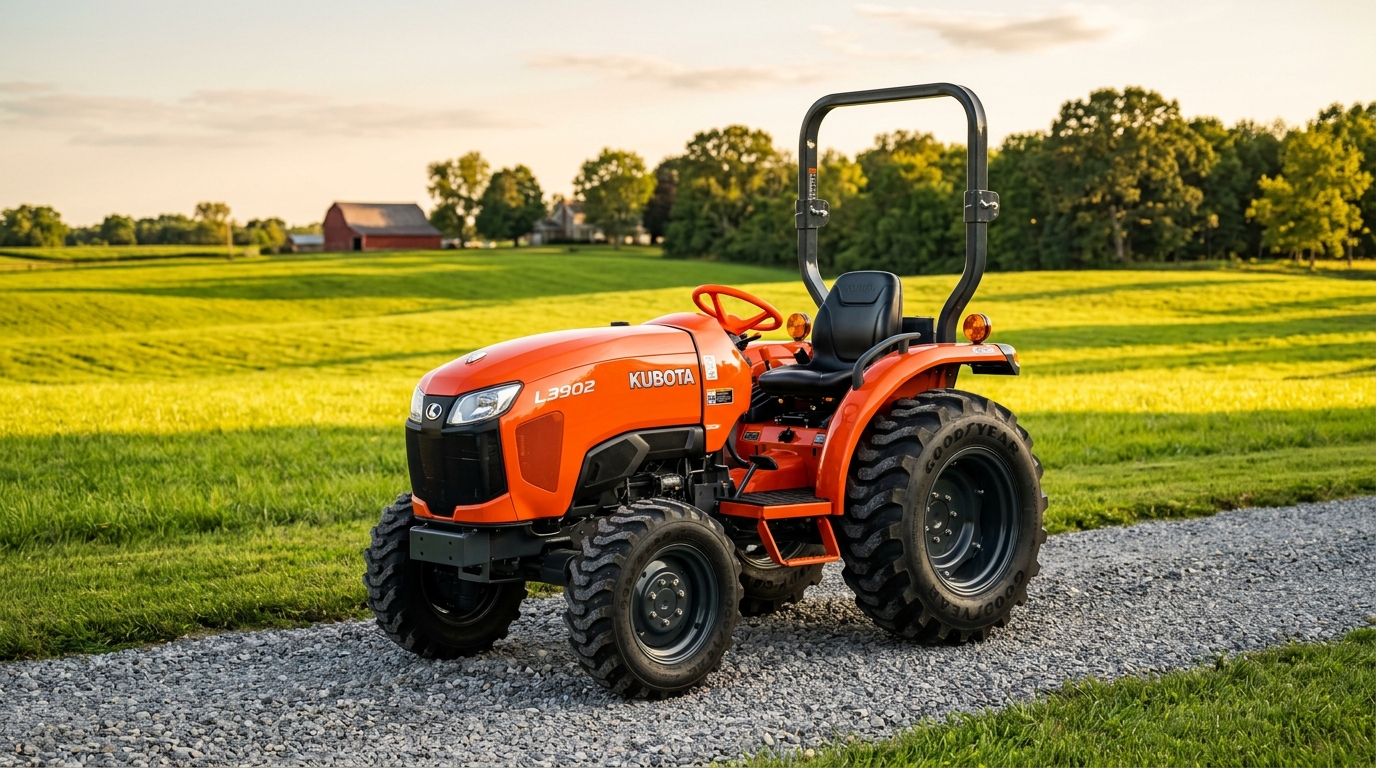
A tractor three-point hitch is standardized under ISO 730 and SAE J711 into five primary categories based on tractor horsepower and structural dimensions. Category 0 (under 20 HP) uses 5/8-inch lower pins and 20-inch arm spread. Category 1 (20 to 45 HP) uses 7/8-inch lower pins, a 3/4-inch top link pin, and a 26-inch arm spread. Category 2 (40 to 125 HP) steps up to 1-1/8-inch lower pins, a 1-inch top pin, and a 32-inch arm spread. Category 3 (80 to 225 HP) uses 1-7/16-inch lower pins, a 1-1/4-inch top pin, and a 38-inch spread. Category 4 (over 180 HP) utilizes 2-inch pins and a 48-inch spread. Sub-compact tractors often feature Category 1 Limited hitches, which share standard 7/8-inch pins but restrict maximum vertical lift height, preventing them from raising standard Cat 1 implements off the ground.
table_chart Benchmark Specifications by Horsepower Tier
| Model | Engine HP | PTO HP | Hydraulic Flow | Hitch Lift | Primary Application |
|---|---|---|---|---|---|
| Kubota BX23S (Category 1 Limited) | 21.6 HP Sub-Compact | Pin sizes: 7/8 in lower, 3/4 in top link | Arm spread: 26 in (restricted lift geometry) | 680 lbs lift capacity at 24 in | Light Cat 1 implements engineered with reduced tower heights and short mast geometry |
| Kubota L3902 (Standard Category 1) | 37.5 HP Compact Utility | Pin sizes: 7/8 in lower, 3/4 in top link | Arm spread: 26 in standard ISO spread | 1,985 lbs at 24 in behind pins | Full-height Cat 1 rotary cutters, 6-foot box blades, post hole diggers, and round bale spears |
| Case IH Farmall 75A (Category 2 with Cat 1 Bushings) | 74 HP Utility Tractor | Pin sizes: 1-1/8 in lower, 1 in top link | Arm spread: 32 in with telescopic ends | 3,307 lbs rear lift capacity | Heavy Cat 2 tillage, 8-foot heavy rotary cutters, disc harrows, and large manure equipment |
| John Deere 8400R e23 (Category 4N / 3 Quick Coupler) | 400 rated HP Row Crop Prime Mover | Pin sizes: 1-7/16 in (Cat 3) and 2 in (Cat 4) | Arm spread: 38 in (Cat 3) to 48 in (Cat 4) | 20,000 lbs (9,072 kg) electro-hydraulic lift | Heavy multi-shank chisel rippers, 16-row mounted planters, and vertical tillage toolbars |
Published Field Deep Dives in This Topic Cluster
This pillar guide establishes the core formulas for implements, attachments & hitch geometry. Explore our published companion evaluations for detailed model breakdowns and laboratory test data:
A certified agricultural engineering guide to sizing rotary cutters and brush hogs: the rule of 5 PTO horsepower per foot of cut, slip clutch vs shear bolt drivelines, deck gauge thickness, and tractor ballast safety.
A technical guide to understanding tractor front end loader lift ratings: why pivot pin numbers mislead buyers, calculating real payload capacity 500mm ahead of pins, breakout force physics, and rear ballast requirements.
1. The Five Hitch Categories: Dimensional Chart of Pins, Spreads, and Horsepower
2. The Category 1 Limited Trap on Sub-Compact Tractors
3. Top Link Geometry, Pitch Angle, and Mechanical Draft Control
4. Lower Lift Arm Stabilization: Sway Chains, Turnbuckles, and Telescopic Links
5. Stepping Up and Down: Using Hitch Bushing Adapters Safely
6. Quick Hitch Standards: ASAE S278.6, iMatch, and Floating Top Hooks
Equipment Buyer's Verification Checklist
Three-Point Hitch Inspection and Compatibility Checklist
- check_box_outline_blank Determine your tractor true hitch category (verify pin diameters: 7/8 in for Cat 1, 1-1/8 in for Cat 2)
- check_box_outline_blank Check whether your sub-compact tractor has Category 1 Limited lift height before buying full-size implements
- check_box_outline_blank Inspect lift arm ball ends for excessive oval wear, cracking, or stripped grease zerks
- check_box_outline_blank Verify stabilizer turnbuckles or sway bars lock securely to prevent lateral tire contact
- check_box_outline_blank Ensure top link threads are greased, turn freely by hand, and include locking jam nuts
- check_box_outline_blank Confirm implement weight is well within 80 percent of tractor rated three-point lift capacity at 24 inches
- check_box_outline_blank Check quick hitch compatibility: verify implement mast height and lower pin spread match ASAE S278.6 dimensions
- check_box_outline_blank Always install safety linchpins with spring-loaded rings; never substitute bent nails or wire
help_outline Frequently Asked Questions
Can I use Category 1 implements on a Category 2 tractor?
Yes, provided you install hardened steel adapter bushings on the implement lower hitch pins (converting them from 7/8-inch to 1-1/8-inch outside diameter) and on the top link pin (converting from 3/4-inch to 1-inch). You must also adjust your tractor lower lift arm sway chains or bars outward to match the narrower 26-inch Category 1 pin spread.
What is a Category 1 Limited hitch?
A Category 1 Limited hitch is found on sub-compact tractors. It uses standard Category 1 pin diameters (7/8-inch lower, 3/4-inch top) and a 26-inch spread, but the tractor small chassis and low rear tires limit the total vertical lift stroke to around 12 to 14 inches (compared to 18 to 22 inches on standard compacts). As a result, tall implements cannot be raised high enough to clear the ground during transport.
What is tractor draft control and how does it work?
Draft control is an internal hydraulic sensing mechanism designed for ground-engaging tillage tools like plows, subsoilers, and heavy cultivators. When the implement encounters dense soil or an obstruction, the increased resistance exerts compressive force on the tractor top link or lower draft arms. The tractor hydraulic valve senses this load and automatically lifts the three-point hitch slightly to maintain constant engine load and transfer traction down to the drive tires, preventing the tractor from spinning out.
Why does my quick hitch not fit all of my three-point implements?
Quick hitches conform to strict ASAE S278.6 dimensions requiring a 27-1/4 inch lower hook spread and a precise 15-inch vertical distance to the top hook. Many older implements or economy attachments were fabricated with non-standard mast heights or non-standard lower pin widths. To connect non-compatible implements, you need an adjustable floating top hook bracket or quick-hitch adapter kit.
Specialist with All About Tractors, focusing on agricultural powertrain performance, implement geometry, and field test diagnostics. All specifications cross-referenced with certified manufacturer technical sheets.