John Deere 4020 vs International Harvester 1066: The Legendary Row-Crop War
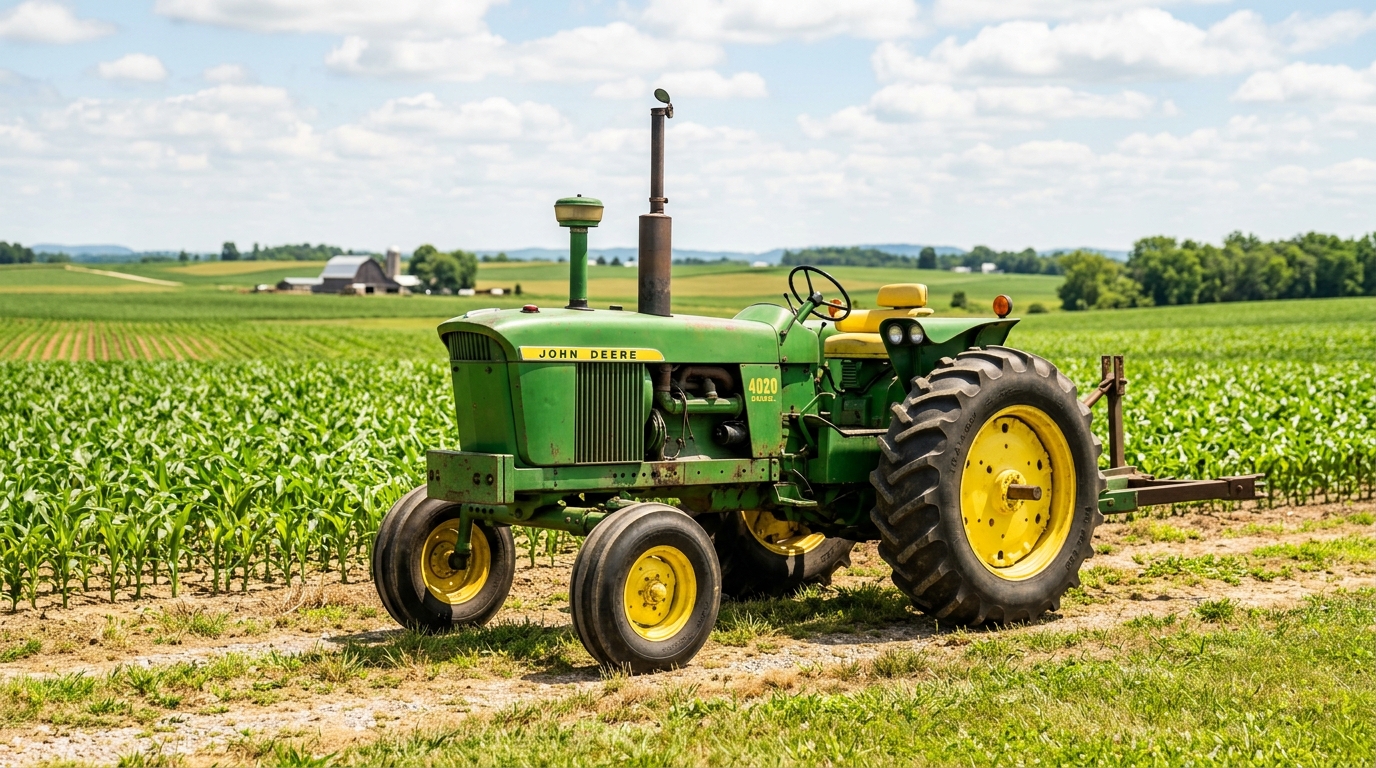
The battle between the John Deere 4020 (produced 1963-1972) and the International Harvester 1066 Turbo (produced 1971-1976) defined mid-century agricultural mechanization and divided farm families across the American Midwest. The John Deere 4020 delivered 95 PTO horsepower from a legendary 404 cubic-inch (6.6L) naturally aspirated six-cylinder diesel, celebrated for its revolutionary closed-center hydraulic system and optional 8-speed full PowerShift transmission that allowed clutchless shifting under heavy load. The IH 1066 answered with raw horsepower brute force, extracting 125 PTO horsepower from a turbocharged 414 cubic-inch (6.8L) DT-414 diesel engine paired with IH famous on-the-go mechanical Torque Amplifier (TA) underdrive. While the 1066 outperformed the 4020 in raw horsepower-per-dollar and heavy disk pulling, the Deere 4020 set the universal standard for operator controls, hydraulic response, and hydraulic implement convenience.
This field report is an operational deep dive within our Head-to-Head Benchmark Battles & Brand Rivalries series. For the foundational engineering formulas and sizing benchmarks, read our primary pillar guide: The 800+ HP Monster Tractor Battle: John Deere 9RX 830 vs Case IH Steiger 715 Quadtrac vs CLAAS Xerion 12.650 .
table_chart Benchmark Specifications by Horsepower Tier
| Model | Engine HP | PTO HP | Hydraulic Flow | Hitch Lift | Primary Application |
|---|---|---|---|---|---|
| John Deere 4020 Diesel (The Waterloo Icon) | 95.8 PTO HP (Nebraska Test 848) 404 cu in 6.6L Diesel | Dual 540 / 1000 RPM reversible shaft | Closed-center variable displacement hydraulic pump (13 GPM at 2,000 psi) | Syncro-Range 8-speed or full 8-speed PowerShift | Precision loader work, row-crop cultivating, and unmatched classic tractor collector liquidity |
| International Harvester 1066 Turbo (The Red Powerhouse) | 125.9 PTO HP (Nebraska Test 1077) DT-414 Turbocharged 6.8L | Dual speed independent 540 / 1000 RPM PTO | Open-center tandem gear pumps (12 GPM primary + 9 GPM steering) | 16-speed sliding gear with mechanical Torque Amplifier (TA) | Heavy high-draft moldboard plowing, deep chisel tillage, and 125-horsepower field pulling |
| Massey Ferguson 240 (Classic Heritage Counterpart) | 46 HP Perkins 3-cylinder Diesel | Standard 540 RPM Live PTO | Mark III Ferguson hydraulic pump | 3,100 lbs rear three-point lift capacity | Understanding the mechanical utility tier of 1970s and 1980s tractor heritage |
| John Deere 8400R e23 (Modern Row-Crop Descendant) | 400 rated HP 9.0L PowerTech Twin-Turbo | 335 PTO HP (1000 RPM) | 85 GPM dual-pump closed-center PFC hydraulics | 20,000 lbs Category 4N/3 three-point hitch | Seeing how the 4020 closed-center hydraulic and powershift DNA evolved into modern flagships |
1. The 1970s Farm War: Why Green vs Red Divided American Agriculture
2. Engine Architecture: Naturally Aspirated 404 vs Turbocharged DT-414
3. Drivetrain Faceoff: Deere 8-Speed PowerShift vs IH Torque Amplifier (TA)
4. Hydraulic Revolution: John Deere Closed-Center System vs IH Open-Center Tandem Pumps
5. Nebraska Tractor Test Benchmarks: Fuel Economy and Drawbar Pull Numbers
6. Modern Collector Values: Auction Benchmarks and Restoration Parts Availability
Equipment Buyer's Verification Checklist
Classic Row-Crop Tractor Inspection and Buyer Checklist
- check_box_outline_blank Check engine serial stamping on block side rail to verify original factory displacement
- check_box_outline_blank Test John Deere PowerShift transmission in all 8 forward and 4 reverse speeds under working load
- check_box_outline_blank Test IH Torque Amplifier (TA) lever: verify crisp lockup in high and low without freewheeling downhill
- check_box_outline_blank Inspect hydraulic oil clarity: check for milky moisture contamination or burnt hydraulic fluid smell
- check_box_outline_blank Check steering play: verify hydraulic steering valve seals and inspect tie rod ends for oval wear
- check_box_outline_blank Inspect rear axle trumpet housings and differential casting for structural welding or stress cracks
- check_box_outline_blank Verify dual 540/1000 RPM PTO shaft splines and inspect internal PTO clutch engagement brake
- check_box_outline_blank Inspect radiator core and water pump weep hole for green coolant staining or internal rust buildup
Companion Field Evaluations in This Series
Explore related laboratory evaluations and implement matching guides published within the Head-to-Head Benchmark Battles & Brand Rivalries cluster:
A physical test comparison between the two best-selling sub-compact tractors in North America: Kubota BX23S vs John Deere 1025R. C...
help_outline Frequently Asked Questions
Which tractor was more powerful: the John Deere 4020 or the IH 1066?
The International Harvester 1066 was significantly more powerful. In official Nebraska Tractor Test reports, the turbocharged IH 1066 delivered 125.96 PTO horsepower, compared to 95.84 PTO horsepower on the naturally aspirated John Deere 4020. The 1066 was designed to pull heavy 5-bottom and 6-bottom moldboard plows that would stall a 4020.
What is the common failure point on an IH 1066 Torque Amplifier?
The most common failure on the IH Torque Amplifier (TA) is wear on the mechanical one-way sprag clutch and hydraulic direct-drive clutch pack. When the TA wears out, the tractor freewheels when descending hills in low TA, slips under heavy load, or loses drive entirely when the TA lever is pulled back. Rebuilding a failed TA requires splitting the tractor chassis at the bell housing.
Why is the John Deere 4020 considered so revolutionary?
The 4020 was revolutionary because it introduced high-capacity closed-center hydraulics and a full 8-speed PowerShift transmission to mainstream agriculture. Instead of fighting heavy manual steering, jerky open-center hydraulic levers, and mechanical dry clutch gears, the 4020 gave operators effortless power steering, power wet disc brakes, and instant clutchless shifting on the go.
Why do John Deere 4020 tractors cost more than IH 1066 tractors today?
John Deere 4020 tractors command higher collector prices (often 25,000 to 40,000 dollars for pristine side-console models) due to widespread collector nostalgia, unmatched brand prestige, and superior hydraulic loader ergonomics. The IH 1066, while delivering 30 more horsepower, remains viewed primarily as a heavy working chore tractor, selling between 14,000 and 22,000 dollars.
Specialist with All About Tractors, focusing on agricultural powertrain performance, implement geometry, and field test diagnostics. All specifications cross-referenced with certified manufacturer technical sheets.